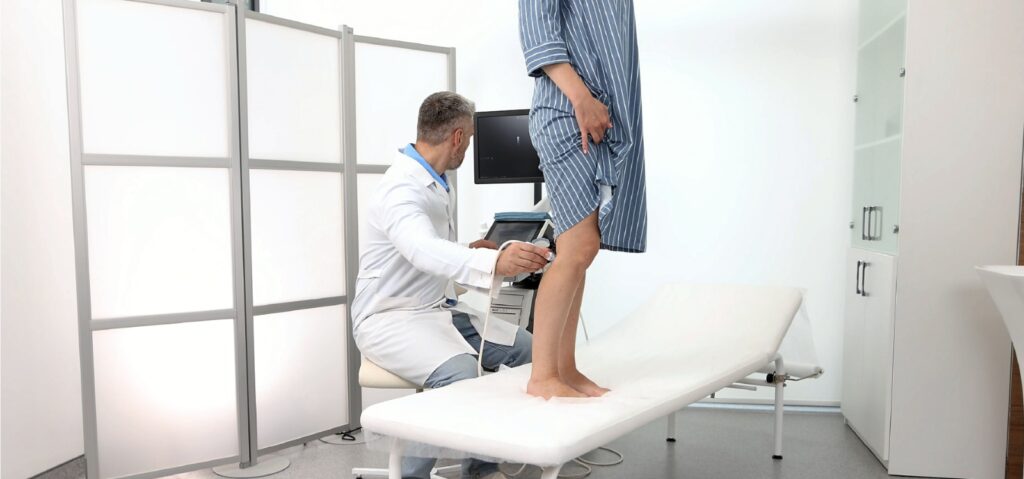
Notice one leg swelling more than the other? Or a calf ache that won’t fade, even after rest? Most people blame tiredness. But sometimes it’s a sign something’s wrong with blood flow. There’s nothing to worry about, a simple test can give you clear answers, no needles, no radiation, no downtime.
Key Takeaways
- A venous Doppler ultrasound checks how blood is moving through your leg veins using sound waves alone.
- It is one of the fastest, safest ways to catch a blood clot before it becomes dangerous.
- The test is painless, takes under an hour, and needs zero prep.
- Central Florida’s climate and travel habits make this test more common here than people realize.
What Is a Venous Doppler Ultrasound?
Think of it like a traffic report for your veins. This test uses sound waves to see how blood flows through the veins in your legs. It can tell your doctor if the flow is smooth, sluggish, or completely stopped in a section of the vein.
Doctors most often order this test when they suspect deep vein thrombosis, better known as DVT. That is a blood clot that forms deep inside a leg vein, and it can turn serious fast if it is not caught in time.
When Should You Get This Test?
Your body usually gives warning signs before things get worse. Pay attention if you notice:
- Swelling that shows up in just one leg
- A heavy, aching, or cramping feeling in your calf or thigh
- Skin that feels unusually warm or looks red in one spot
- Varicose veins that have started to hurt or throb
- Recent surgery, a long flight, or a history of clotting problems
If any of these sound familiar, talk to your doctor rather than waiting it out.
Who Is Most at Risk?
Anyone can develop a blood clot, but some people carry a higher risk than others. You may want to be extra cautious if you are:
- Over the age of 60
- Pregnant or recently gave birth
- Taking birth control pills or hormone therapy
- A smoker or overweight
- Sitting for long stretches due to a desk job, illness, or travel
- Someone with a family history of blood clots or clotting disorders
If more than one of these applies to you, tell your doctor, even if your symptoms feel mild. Risk factors add up, and catching a problem early is always easier than treating it later.
Walking Through the Exam
The process is simpler than most people expect. You lie down comfortably while a technologist applies a bit of gel to your leg and glides a small probe over your skin. The probe sends out sound waves and picks up how your blood moves underneath. At certain points, the technologist may press gently on your leg. This helps show how well your veins respond, which adds useful detail to the results.
From start to finish, expect the appointment to take about 30 to 45 minutes. No fasting beforehand, no contrast dye, and no recovery time afterward. You can go straight back to your day.
A Local Angle Worth Knowing
Florida life comes with its own set of risk factors. The heat and humidity can make ordinary leg swelling feel worse than it would in a cooler place. On top of that, long car rides to visit family or full days spent walking through theme parks can quietly raise your risk of developing a clot, especially if you are sitting still for hours at a time. If you notice your legs swelling more than usual after a hot day or a long trip, mention it at your next appointment rather than assuming it will pass on its own.
Why Catching It Early Makes All the Difference
Catching a clot early can change everything. A clot sitting quietly in your leg does not always stay there. If it breaks free, it can travel through your bloodstream and lodge in your lungs, causing a pulmonary embolism. That is a medical emergency. Finding the clot early through imaging gives your doctor the chance to start treatment immediately, long before it becomes life-threatening.
Your Answers Are One Scan Away
Leg pain and swelling deserve more than a guess. A.T. Radiology offers venous Doppler ultrasound at our Winter Haven, Davenport, and Lake Wales locations, with fast scheduling and quick results. Take the first step toward feeling like yourself again.
FAQ
Can this test miss something?
It is very reliable for thigh and knee veins, but small clots in the calf can sometimes be harder to detect.
How long for results?
A radiologist usually reviews the images the same day. Your doctor typically receives the report within one or two days.
Is this different from a regular ultrasound?
Yes, Doppler also measures how fast and in which direction your blood is moving.
Will insurance cover it?
Most plans, including Medicare, cover it when a doctor orders it for symptoms like pain or swelling.
How often should I be scanned if I have varicose veins?
It depends on your symptoms; some need a one-time scan, while others benefit from periodic checks.
Our imaging services include: 3D Mammogram, Ultrasounds, Sonograms, X-Rays, MRI Scans, 3D Sonogram, Echocardiograms, Prostate MRI, Bone Density Scan, Arthrograms, CT Low-Dose Lung Cancer Screening, Lung Cancer Screening, CT Scan, and OB Ultrasound.